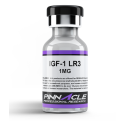
IGF-1 LR3
The content, articles and product information provided on this website are strictly educational and informational. They are intended to be used for in vitro research only. “In vitro” is a Latin phrase, “in glass,” that refers to research that is conducted outside of a living organism. Note, these products are not pharmaceuticals or medicines and have not been approved by the FDA for the diagnosis, treatment or prevention of any illnesses or disorders. These products are legally prohibited from human or animal consumption.
-
Posted: April 13, 2026Read more »
How to Reconstitute PEG-MGF: Step-by-Step Laboratory Preparation Guide
PEG-MGF (Pegylated Mechano Growth Factor, PEGylated IGF-1Ec splice variant peptide, MW ~4000 Da including PEG) is a synthetic analogue of Mechano Growth Factor incorporating a polyethylene glycol (PEG) modification that extends plasma stability and half-life relative to the native MGF peptide. It is supplied as a lyophilised powder in a 10mL sterile glass vial containing 2mg of peptide. The PEG modification requires specific handling considerations during reconstitution to ensure complete dissolution and maintain compound integrity for IGF-1R and myocyte cell model research.
Materials Required
- PEG-MGF 2mg lyophilised vial
- Bacteriostatic water (BAC water) — 10mL vial
- 1mL sterile syringe with needle
- Alcohol swabs (70% isopropyl)
- Nitrile gloves
- Permanent marker for labelling
Pre-Reconstitution Preparation
Inspect t
-
Posted: April 13, 2026Categories: IGF-1 LR3Read more »
How to Reconstitute IGF-1 DES: Step-by-Step Research Lab Protocol
IGF-1 DES (Des(1-3)-IGF-1, MW ~7368 Da) is a truncated IGF-1 analogue lacking the first three N-terminal amino acids (Gly-Pro-Glu) of native IGF-1. This truncation substantially reduces IGFBP-3 binding affinity while maintaining full IGF-1R binding capacity, resulting in significantly increased potency at IGF-1R in IGFBP-containing cell culture conditions. It is supplied as a lyophilised powder in a 10mL sterile glass vial containing 1mg of peptide.
Materials Required
- IGF-1 DES 1mg lyophilised vial
- Sterile 0.1% acetic acid for reconstitution
- Sterile PBS + 0.1% BSA for working dilutions
- 0.5mL or 1mL sterile syringe with needle
- Alcohol swabs (70% isopropyl)
- Nitrile gloves
- Permanent marker for labelling
Important Note on Solvent Selection
Like IGF-1 LR3, IGF-1 DES is reconstituted in sterile 0.1% acetic
-
Posted: April 13, 2026Read more »How to Reconstitute IGF-1 LR3: Laboratory Preparation Guide for Research IGF-1 LR3 (Long R3 IGF-1, MW ~9117 Da) is a recombinant 83-amino acid IGF-1 analogue incorporating an N-terminal 13-amino acid extension and Glu3→Arg3 substitution that reduce IGFBP binding affinity by approximately 1000-fold while maintaining IGF-1 receptor binding. It is supplied as a lyophilised powder in a 10mL sterile glass vial containing 1mg of peptide. Due to its large molecular weight and protein-like structure, IGF-1 LR3 requires specific reconstitution considerations to maintain biological activity in cell model research applications. Materials Required IGF-1 LR3 1mg lyophilised vial Sterile 0.1% acetic acid or sterile water for reconstitution Sterile PBS or cell culture media for further dilution 0.5mL or 1mL sterile syringe with needle Alcohol swabs (70% isopropyl) Nitrile gloves Permanent marker for labelling Refrigerator at 2–8°C for storage Important Note on Solvent Selection IGF
-
Posted: January 09, 2026Read more »
Introduction
Muscle wasting and GH resistance pose major clinical concerns to millions worldwide, ranging from the elderly on AD related muscle loss population to patients suffering from chronic diseases. Over the past decade peptides IGF 1 LR3 have become an exciting area of science because they have several applications to medicine and are likely to be related to muscle retention during catabolic states as well as therapeutic healing processes in cases where the body suddenly can’t maximize on growth hormone.
As opposed to traditional GH therapy, peptides (such as IGF
-
Posted: December 29, 2025Categories: Research Peptides, BPC 157, TB-500, IGF-1 LR3, CJC 1295, GHRP 6, Bacteriostatic Water, GHRP 2Read more »
Knowing the correct IGF 1 LR3 dosage is highly important for everyone interested in using this modified peptide hormone. And if you're a researcher, clinician or knowledgeable nootropic explorer dissecting the prospects of peptide therapeutics, both effective and safe dosing protocols - as well as cycle durations are key elements that determine one from the other. This complete guide covers everything from the basic IGF LR3 cycle lengths,doses and administration regimen to advanced cycles for anabolic muscle growth as well.
Important: This information is presented for research and educational purposes only. IGF 1 LR3 is not FOR for human consumption and can only be used in legitimate research facilities. Peoples who
-
Posted: December 26, 2025Categories: Research Peptides, BPC 157, TB-500, Semaglutide, Sermorelin, PT-141, Melanotan 2, Hexarelin, IGF-1 LR3, Selank, Ipamorelin, Tesamorelin, Epithalon, CJC 1295, GHRP 6, AICAR, GHRP 2Read more »
Introduction
Biomedical research in the twenty-first century has been redefined by the discovery and application of peptides—short chains of amino acids that represent one of nature’s most potent signaling molecules. The number of peptides involved in regenerative and metabolic research has increased exponentially as researchers delve deeper into the complex processes that drive tissue repair, cellular rejuvenation and metabolism regulation. These scientific peptides are some of the best tools for scientists working to answer fundamental questions about healing, aging, metabolism and disease prevention.
-
Posted: November 13, 2025Read more »
Diabetic neuropathy is one of the most debilitating and common complication associated with chronic diabetes that affects millions worldwide, with gradual nerve damage that conventional therapies fail to cure. New studies on cell regenerative peptides have revealed some of the most exciting prospects for treatment, and one of these is Peptides IGF 1 LR3 one as potential neuroprotection and nerve regeneration therapy. This complete guide explains the science behind, and mechanisms of action and research potential on Peptides IGF 1 LR3 in curing diabetic nerve damage.
Understanding Diabetic Neuropathy's Devastating Impact
Diabetic neuropathy is a continuum of nerve disorders due to chronic hyperglycemia. The condition comes
-
Posted: October 28, 2025Categories: Research Peptides, BPC 157, Hexarelin, IGF-1 LR3, Ipamorelin, Tesamorelin, Epithalon, CJC 1295, GHRP 6, AICARRead more »
Introduction — How Peptides Influence Energy and Metabolism
A new way to fight the world's fatigue, metabolic dysfunctions and lost vitality with energy peptides. These targeted amino acid sequences operate at a cellular level to improve your mitochondria’s ability to generate power, heighten metabolic efficiency and sunny energy production.
The influence of energy peptides on cell metabolism is inseparably connected with the regulation of basic metabolic processes. These peptides do not simply mask symptoms with stimulants, but act directly on cellular pathways, stimulate hormone production and protect mitochondrial structures to address energy deficits at their root.
For anyone wishing to optimize metabolism, increase endurance, expedite fat loss or fight ageing-related weakening energy – grasping how power peptides work within
-
Posted: October 08, 2025Read more »
Introduction to IGF-1 Long R3
IGF-1 LR3 is the most common and widely used IGF-1 peptide in regenerative medicine, which has been treated by billions of patients. It is important for researchers who are involved in muscle gain, cell generation, metabolism or tissue repair studies to know the correct IGF 1 Long R3 dosage.
IGF-1 is produced endogenously and mediates the effects of growth hormone (GH), which stimulates a variety of cell division, differentiation, and survival cascades in an array of tissues. The “Long R3” variant of IGF-1 (human) has an enhanced chain length, compared to the native form – 83 amino acids (as opposed to its native 70) – and a substitution in
-
Posted: August 25, 2025Categories: Research Peptides, BPC 157, Hexarelin, IGF-1 LR3, Ipamorelin, Epithalon, CJC 1295, GHRP 6, AICAR, GHRP 2Read more »
For maximising energy production and cellular repair, researchers and health fanatics are shifting towards peptides as an effective way to boost performance and the drive to power down after a long day. These small chains of amino acids are involved in controlling a wide range of physiological functions from the production of ATP to tissue regeneration. If you’re an athlete who wants to recover faster, a fitness enthusiast who wants to improve endurance, or simply listen to your inner health, wellness aficionado and aging hater, you might be interested in learning about the best peptides for energy and cellular recovery.
This all-encompassing article delves into the science of using peptides for improved energy and cellular repair by breaking down their modes of action, the likely benefits, as well as the current state of research on these compounds. With the increasing interest in these bioactive compounds, it is important to know how