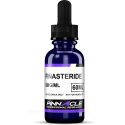
What Is FINASTERIDE 5MG/ML | 60ML?
Finasteride, sold under the brand name Proscar, is a 5α-reductase inhibitor. It is an antiandrogen FDA-approved drug used for the treatment of benign prostatic hyperplasia and male pattern baldness. It has also been shown to be effective in the treatment of hirsutism. Furthermore, researchers are exploring its potential effect on sleep apnea and central serous chorioretinopathy. At Pinnacle Peptides, finasteride for sale is exclusively available for research and experimentation.
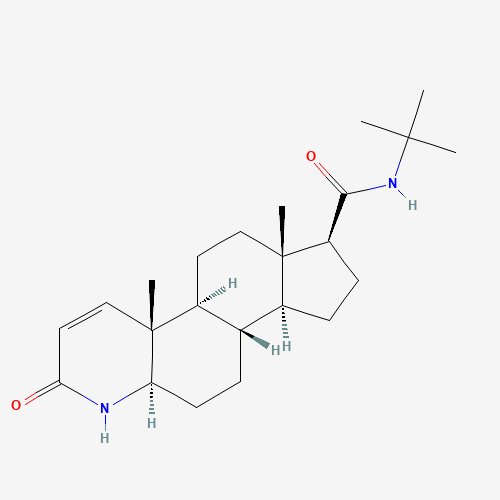
Structure Of FINASTERIDE 5MG/ML | 60ML

From Pubchem
IUPAC Name: (1S,3aS,3bS,5aR,9aR,9bS,11aS)-N-tert-butyl-9a,11a-dimethyl-7-oxo-1,2,3,3a,3b,4,5,5a,6,9b,10,11-dodecahydroindeno[5,4-f]quinoline-1-carboxamide
Synonyms: Proscar, Propecia, Finastid
Molecular Formula: C23H36N2O2
Molecular Weight: 372.5 g/mol
CAS number: 98319-26-7
PubChem CID: 57363
History
A researcher named Imperato-McGinley described a group of male children lacking 5α reductase enzyme in 1974. All of them exhibited low levels of DHT and their postrates remained small throughout their lifetime. This led to the discovery of a drug, finasteride, that could inhibit the 5α reductase enzyme. The drug was patented in 1984 and was approved by the FDA for the treatment of benign prostatic hyperplasia in 1992. Five years later, the FDA also approved it for the treatment of male pattern baldness in 1997.
Mechanism Of FINASTERIDE 5MG/ML | 60ML
Finasteride is a competitive inhibitor of type II and III 5α reductase inhibitor, an enzyme responsible for the conversion of testosterone to dihydrotestosterone (DHT). High levels of DHT are associated with the maturation of follicles and enlargement of the prostate gland.
Literature shows that finasteride has a minimal selectivity towards type I 5α reductase enzyme which is present in sebaceous glands, sweat glands and epidermal keratinocytes. On the other hand, type II 5α reductase is found in the outer sheath of hair follicles, seminal vesicles and prostate glands. Research has shown that finasteride can lower serum DHT levels by 70% and DHTlevels in the prostrate by 90% [1].
Pre-Clinical/Clinical Research
1. Androgenetic Alopecia
Finasteride has been shown to be effective against androgenetic alopecia. Literature suggests this drug improves hair loss by 30% within six months of therapy [2]. Although it is effective, its systemic use causes various side effects, such as gynecomastia, decreased ejaculate volume, male infertility and high-grade prostate cancer. This limits the long-term utilization of the medicine.
Alternatively, topical finasteride show better results for androgenetic alopecia with more favorable side effect profile than systemic therapy. A systemic review concludes that topical finasteride decreases the rate of hair loss and increases total and terminal hair count. Furthermore, it has been shown to effectively reduce the concentration of DHT in both scalp and plasma [3].
Finasteride has also been explored for the female pattern baldness but it didn’t produce any significant results [4]. Moreover, one study was conducted to look at the effect of 5α reductase enzyme inhibitor, finasteride, on androgenic alopecia in female-to-male transgender patients. All the patients who took one 1 mg oral finasteride improved one grade on the Norwood-Hamilton scale after 4-6 months of initiating therapy [5].
2. Central Serous Chorioretinopathy
Central serous Chorioretinopathy (CSC) is an idiopathic disorder characterized by the accumulation of fluid behind the retina causing serous detachment of the macula, resulting in impaired vision. It has been proposed that elevated testosterone levels are associated with the pathogenesis of CSC. Research suggests that 5α reductase enzyme inhibitor, which prevents the conversion of testosterone into dihydrotestosterone, might be effective for treating CSC [6].
One study was designed to evaluate the safety and effectiveness of finasteride in patients with CSC. It found that patients who took finasteride for CSC reported improvement in visual activity. Furthermore, a reduction in macular thickness and subretinal fluid was observed, suggesting the efficacy of finasteride in treating this disorder [7].
3. Prostate cancer
Androgens play a key role in the pathophysiology of prostate cancer. 5α reductase inhibitors, including finasteride, prevent the formation of primary androgen (dihydrotestosterone) in prostate tissues. They might prove effective in treating or preventing prostate cancer.
A study named Prostate Cancer Prevention Trial (PCPT) was designed to study the effect of finasteride on prostate cancer. Almost 19,000 men aged 50 or older having PSA levels of 3ng or lower were enrolled. The subjects were randomly assigned to receive either 5 mg finasteride or an equivalent placebo once a day for seven days. The researchers found that finasteride delays or prevents the occurrence of prostate cancer [8].
Interestingly, it was observed that high-grade tumors were more prevalent in the treatment group as compared to the placebo group [8]. Later, it was suggested that it might be due to finasteride’s impact on prostate volume and its potential to suppress low-grade cancer rather than its effect on tumor morphology. Furthermore, the high-grade tumors were detected earlier and were less extensive in the treatment group as compared to the control group [9].
4. Hirsutism
Hirsutism is a condition characterized by excessive growth of the body and facial hairs. It is often associated with high levels of androgens. Finasteride may benefit people with hirsutism. A study was conducted to check the impact of 5α-reductase inhibitors on hirsutism in women with PCOS. Subjects enrolled in the study were administered with a placebo or finasteride once a day for seven months. The results found that finasteride produced a reduction in hirsutism score and was found to be well tolerated and effective [10].

Summary
Finasteride competitively inhibits 5α-reductase, an enzyme responsible for the conversion of testosterone into dihydrotestosterone. It possesses selectivity and doesn’t affect adrenal synthesis. It is approved by the FDA for the treatment of benign prostatic hyperplasia and alopecia. Furthermore, researchers show that it can reduce the incidence of prostate cancer and might treat central serous chorioretinopathy. We don’t support its unwarranted use and offer finasteride purchase solely for research. Only buy finasteride if you are a qualified researcher.
References
- Zito PM, Bistas KG, Syed K. Finasteride. [Updated 2022 Aug 25]. In: StatPearls [Internet]. Treasure Island (FL): StatPearls Publishing; 2023 Jan-.
- Varothai, S. and W.F. Bergfeld, Androgenetic Alopecia: An Evidence-Based Treatment Update. American Journal of Clinical Dermatology, 2014. 15(3): p. 217-230.
- Lee, S.W., et al., A Systematic Review of Topical Finasteride in the Treatment of Androgenetic Alopecia in Men and Women. J Drugs Dermatol, 2018. 17(4): p. 457-463.
- Levy, L.L. and J.J. Emer, Female pattern alopecia: current perspectives. Int J Womens Health, 2013. 5: p. 541-56.
- Moreno‐Arrones, O.M., A. Becerra, and S. Vano‐Galvan, Therapeutic experience with oral finasteride for androgenetic alopecia in female‐to‐male transgender patients. Clinical and Experimental Dermatology, 2017. 42(7): p. 743-748.
- Forooghian, F., et al., Finasteride for chronic central serous chorioretinopathy. Retina, 2011. 31(4): p. 766-71.
- Moisseiev, E., et al., Finasteride is effective for the treatment of central serous chorioretinopathy. Eye, 2016. 30(6): p. 850-856.
- Thompson, I.M., et al., The Influence of Finasteride on the Development of Prostate Cancer. New England Journal of Medicine, 2003. 349(3): p. 215-224.
- Lucia, M.S., et al., Finasteride and High-Grade Prostate Cancer in the Prostate Cancer Prevention Trial. JNCI: Journal of the National Cancer Institute, 2007. 99(18): p. 1375-1383.
- Tolino, A., et al., Finasteride in the treatment of hirsutism: new therapeutic perspectives. Fertil Steril, 1996. 66(1): p. 61-5.
FINASTERIDE 5MG/ML | 60ML
| Molecular Formula | Molecular Weight | CAS Number | SKU |
|---|---|---|---|
| C23H36N2O2 | 372.5 g/mol | 98319-26-7 | FINASTERIDE-60ML |
Finasteride is a synthetic 4-azasteroid and selective, competitive inhibitor of 5-alpha reductase (5alphaR), specifically targeting type II and type III isoforms. 5alphaR catalyses the conversion of testosterone to DHT in cell-based and cell-free enzymatic assay models.
Research applications include in vitro 5alphaR enzyme kinetics and isoform selectivity characterisation, DHT-mediated androgen receptor signalling pathway studies, and comparative isoform-selective inhibitor pharmacology studies.
Pinnacle Peptides supplies Finasteride at 5mg/ml in a 60ml liquid format. USA-manufactured and verified for concentration accuracy. For laboratory research use only. Store at room temperature.
WARNING: For research purposes only. Not for human or animal consumption. Not intended to diagnose, treat, cure, or prevent any disease. For use by qualified research professionals only.